
Read any modern mechanical keyboard listing and you will almost certainly see the words gasket mount. Over the past few years it has gone from a niche feature on expensive custom kits to a selling point on keyboards under $100. But what does it actually mean, and does it make a difference you can feel?
The short answer: a gasket mount keyboard holds its plate between soft strips or pads of material such as silicone, rubber or Poron foam, instead of screwing it directly to the case. Because there is no hard metal-to-plastic contact, each keystroke is cushioned. The result is usually a softer, slightly bouncy typing feel and a deeper, more muted sound. This guide explains how gasket mounting works, how it compares with tray, top and sandwich mounts, its real downsides and who should (and shouldn’t) pay extra for it.
First, what does “mounting” mean on a keyboard?
Inside a typical mechanical keyboard there are three main layers. The switches clip into a plate, a stiff sheet with square cut-outs. The switches are also soldered or hot-swapped into the PCB (printed circuit board) underneath. That plate-and-PCB assembly then has to be fixed to the case somehow.
The way it is fixed is called the mounting style. It sounds like a small engineering detail, but it decides how much the assembly can move when you press a key, where the force of each keystroke goes, and how vibrations travel into the case. That is why two keyboards with identical switches and keycaps can feel and sound noticeably different.
How a gasket mount works
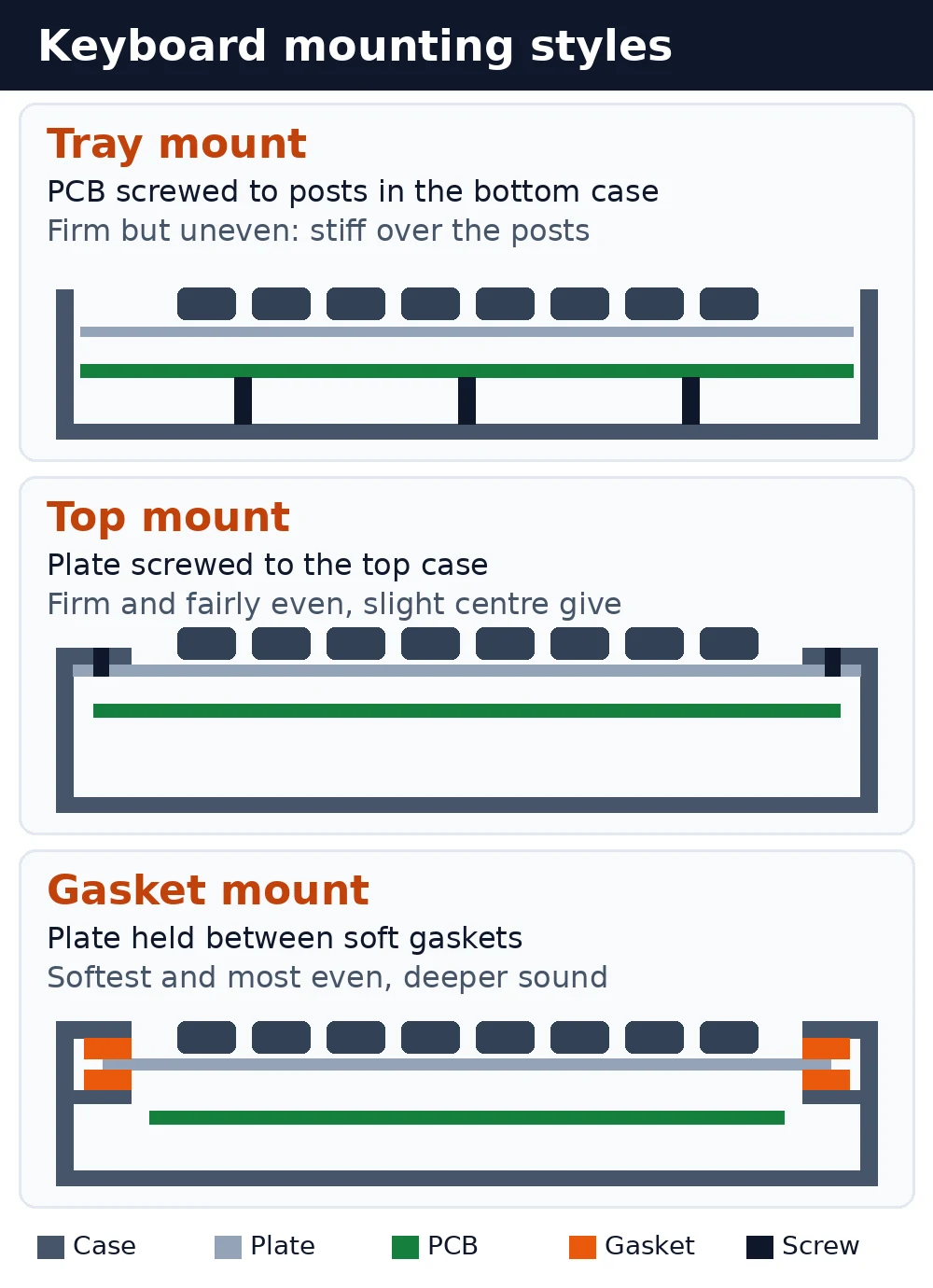
In a gasket-mounted keyboard, the plate (or the whole plate-and-PCB assembly) is sandwiched between gaskets: small pieces of soft, compressible material positioned above and below the plate. The top and bottom halves of the case then press the gaskets together, holding the plate in place by compression rather than screws.
Gaskets are commonly placed on tabs around the edges and corners of the plate, and are often U-shaped so they wrap above and below each tab. Some boards use one continuous strip instead. Common gasket materials include:
- Silicone: durable and fairly firm; very common on mass-market boards.
- Poron: a dense polyurethane foam that compresses evenly and is popular on custom keyboards.
- Rubber or EVA foam: cheaper options used on some budget boards.
Because the plate floats on these cushions with no rigid contact point, it can move very slightly downward when you type. That small amount of give is what people mean by “flex” or “bounce”. It also means less vibration passes directly into the case, which is why gasket mounts tend to sound less hollow and less pingy.
The main keyboard mounting styles compared
Gasket mounting is easiest to understand next to the alternatives. These are the styles you are most likely to see on product pages:
Tray mount
The PCB is screwed straight into raised posts (standoffs) in the bottom of the case. It is the cheapest and most common method, used on most office and entry-level gaming keyboards. The downside is an uneven feel: keys right above a screw post feel stiff, while keys between posts feel slightly softer. Some boards add O-rings or rubber washers at the screw points, sometimes called a “burger mount” or modified tray mount, to soften this.
Top mount
The plate is screwed to the underside of the top half of the case. This is common on custom keyboards. The feel is more consistent than tray mount, with a little give towards the centre of the board, and the sound is generally fuller.
Bottom mount
The inverse of top mount: the plate is screwed to the bottom half of the case. Typing feel is similar to top mount, but it is less popular among enthusiasts.
Sandwich mount
Long screws pass through the bottom case, the plate and the top case, clamping all three together. This creates a firm, evenly stiff feel with very little flex.
Integrated plate
The plate is part of the case itself, moulded or machined as one piece. This is the most rigid option and is found on some budget boards and some high-end aluminium designs.
Gasket mount (and close relatives)
The plate is held between soft gaskets with no direct screws to the case, giving the softest and most even feel. Closely related designs include O-ring mount, where a rubber ring wrapped around the plate edge provides the cushioning, and leaf-spring mount, where flexible tabs on the plate do the job. Both aim for the same cushioned result.
Mounting styles at a glance
| Mount | Feel | Sound | Typical use |
|---|---|---|---|
| Tray | Firm, uneven | Can be hollow | Budget, office |
| Top | Firm, even | Full | Custom kits |
| Sandwich | Stiff, even | Sharper | Some customs |
| Integrated | Most rigid | Sharp | Budget & premium |
| Gasket | Soft, even | Deeper, muted | Most enthusiast boards |
These descriptions are general tendencies, not fixed rules. As the next section explains, the plate, foam and case matter just as much.
Why gasket mount became so popular
Gasket mounting started out on custom keyboard kits, where enthusiasts chased a softer feel and a deeper “thocky” sound. As those boards became popular online, mainstream brands adopted the design, and it is now one of the most common features on enthusiast keyboards at almost every price.
Several boards we have covered use it. The NuPhy Halo65 V2 and the EPOMAKER x AULA F65 in our best 65% keyboards guide are both gasket-mounted, with the F65 pairing its gaskets with a flex-cut polycarbonate plate. Keychron’s Q Max series uses what it calls a double-gasket design, and the ASUS ROG Azoth uses silicone gaskets. You will find more examples in our best 75% keyboards roundup.
Benefits of a gasket mount keyboard
- Softer, more comfortable typing. The slight cushion reduces the hard bottom-out feeling, which many people find more pleasant during long sessions.
- More consistent feel across the board. With no screw posts under specific keys, every key tends to feel similar.
- Deeper, more muted sound. Less vibration reaches the case, so there is usually less ping and hollowness. If noise is a priority, also see how to make a keyboard quieter.
- Pairs well with modern features. Many gasket boards also include hot-swap sockets and layers of internal foam, making them good starting points for tuning.
Drawbacks to know before you buy
- Can feel spongy. If you prefer a crisp, firm keyboard, a soft gasket mount with a flexible plate may feel mushy.
- More complex to build and repair. Gaskets must be positioned correctly when you reassemble the board, and they can shift or compress over time.
- Usually costs more. The extra parts and assembly add cost, although the gap has narrowed a lot.
- Marketing can overpromise. “Gasket mount” on a listing does not guarantee a great feel. Implementation quality varies, and some budget boards use very stiff gaskets that add little.
The plate and foam matter as much as the mount
Mounting style is only one part of the story. The plate material has a huge effect on flex and sound. Polycarbonate (PC) and FR4 plates are flexible and soft-sounding; aluminium is a middle ground; brass and steel are stiff and bright. Many gasket boards also add flex cuts, slots cut into the plate that let sections bend more freely.
This is why a gasket mount with a brass plate can feel much more rigid than a sandwich mount with a polycarbonate plate. Internal foam layers, the case material and even your keycap plastic all shape the final sound too. Switch choice and preparation matter as well; a well lubed set of switches will usually change the sound more than the mount alone.
How to tell if a keyboard is gasket mounted
Manufacturers almost always advertise gasket mounting because it is a selling point, so start with the spec sheet or product page. If it is not mentioned, the board is probably tray or plate mounted. A few other clues help:
- Exploded diagrams: product pages often show the internal layers; look for strips or pads around the plate edges.
- Visible screws: screws on the underside going into the middle of the board usually point to a tray mount.
- Reviews and teardowns: look for photos of the plate tabs and gaskets when the case is opened.
Do you need a gasket mount keyboard?
Choose a gasket mount if you type a lot, prefer a softer and quieter feel, or want a deeper sound without heavy modding. It is also a good base if you plan to experiment with switches on a hot-swappable keyboard.
A tray, top or integrated mount may suit you better if you like a firm, precise bottom-out, you are on a tight budget, or you mainly game and care more about features like polling rate and switch type than typing feel. A well-tuned tray mount board can still sound and feel very good.
If you want full control over every layer, building your own is the best way to learn what you like. Our guide on how to build your own mechanical keyboard walks through choosing a case, plate and mounting style.
Frequently asked questions
Is a gasket mount keyboard quieter?
Usually it sounds softer and less hollow, because the gaskets absorb some vibration before it reaches the case. It does not make loud switches silent, though. Switch type and keycaps have a bigger effect on overall volume. Our article on whether mechanical keyboards are loud covers this in more detail.
Is gasket mount better for gaming?
Not inherently. Mounting style affects comfort and sound, not speed or accuracy. Some gamers prefer a firmer board for a more precise bottom-out, while others like the softer gasket feel. It comes down to personal preference.
Can I convert a tray mount keyboard to gasket mount?
Generally no, because the mounting style is part of the case design. On some tray-mount boards you can add O-rings or soft washers at the screw points, or extra foam, to get a slightly softer feel, but it will not be the same as a true gasket mount.
Do gaskets wear out?
Gaskets can compress or shift over years of use, especially foam types. On most boards they are cheap and easy to replace when you open the case, so this is rarely a serious issue.
What does “double gasket” mean?
Brands use the term for designs with two layers of gasket isolation, for example gaskets on both the plate and an additional layer between other internal parts. Exact designs vary by manufacturer, so check the product’s own description.
The bottom line
A gasket mount keyboard cushions its plate with soft material instead of screwing it to the case, giving a softer, more even and usually deeper-sounding typing experience. It is a real improvement for many typists, but it is not magic: plate material, foam, switches and build quality all matter just as much. If you like a soft, muted feel, a gasket mount is well worth looking for. If you prefer firm and crisp, don’t feel you have to pay extra for it.
