

Quick answer
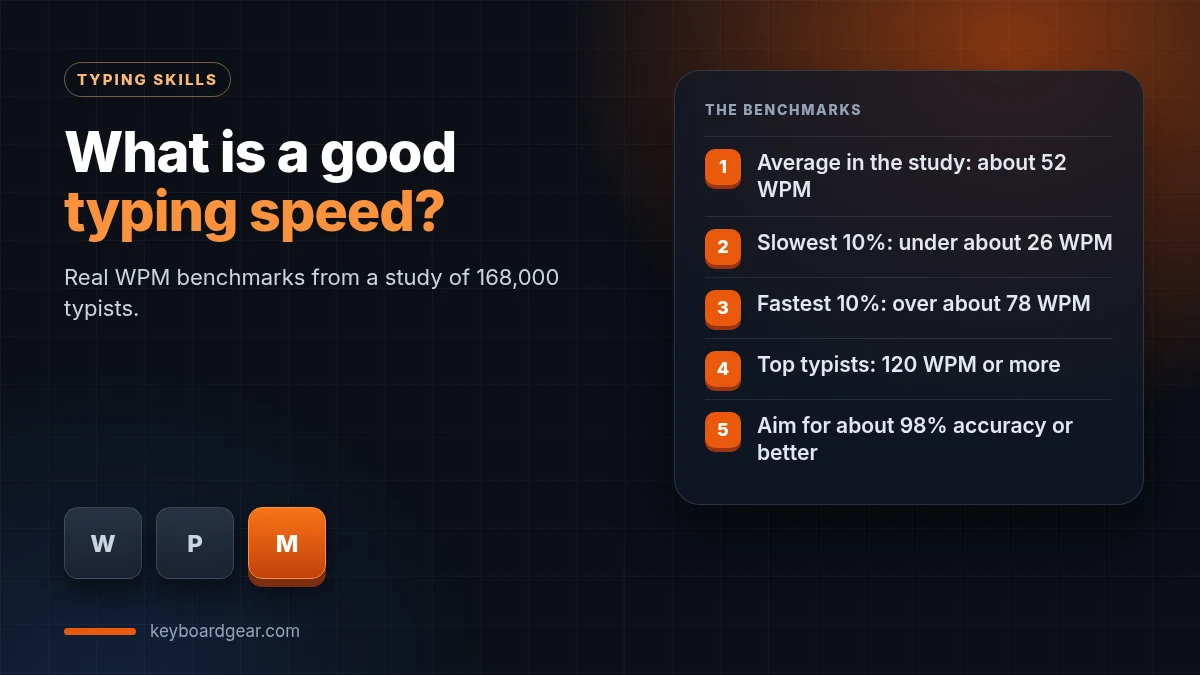
In the largest published study of everyday typing, 168,000 volunteers averaged about 52 words per minute (WPM). A speed of 40 WPM is a reasonable working level, 60 to 75 WPM is good, and anything over about 78 WPM put a typist in the fastest 10% of that study.
Speed only counts if it is accurate. Aim to keep your error rate low, ideally 98% accuracy or better, before chasing higher numbers.
Typing speed is usually measured in words per minute, or WPM. It is one of the easiest skills to test, which is why typing sites, job tests and friends comparing scores all use it. But a number on its own means little until you know what normal looks like, how the test was measured and how accurate you were.
This guide gives you real benchmarks from a large research study, explains how WPM is calculated, and helps you judge whether your own speed is good for the work you do. If you want to get faster, our step-by-step guide on how to type faster picks up where this one ends.
The research: 168,000 typists
In 2018, a team led by researchers at Aalto University in Finland published Observations on Typing from 136 Million Keystrokes, presented at CHI, the main human-computer interaction conference. Volunteers took a scientific typing test on a free typing website, copying 15 sentences each. After filtering, the study analysed about 168,000 people.
| Measure | Result |
|---|---|
| Average speed | 51.56 WPM (standard deviation 20.2) |
| Fastest typists | 120 WPM or more |
| Fastest 10% | Above about 78 WPM (group average about 90 WPM) |
| Slowest 10% | Below about 26 WPM (group average about 21 WPM) |
| Typists who had taken a typing course | About 5 WPM faster on average than those who had not |
| Average uncorrected error rate | 1.17% of characters |
A caution: these were volunteers who chose to take a typing test, with an average age of 24.5, and 72% said they had taken a typing course. They are probably a little faster than the population as a whole. Treat the figures as a guide to what is realistic, not as a strict national average.
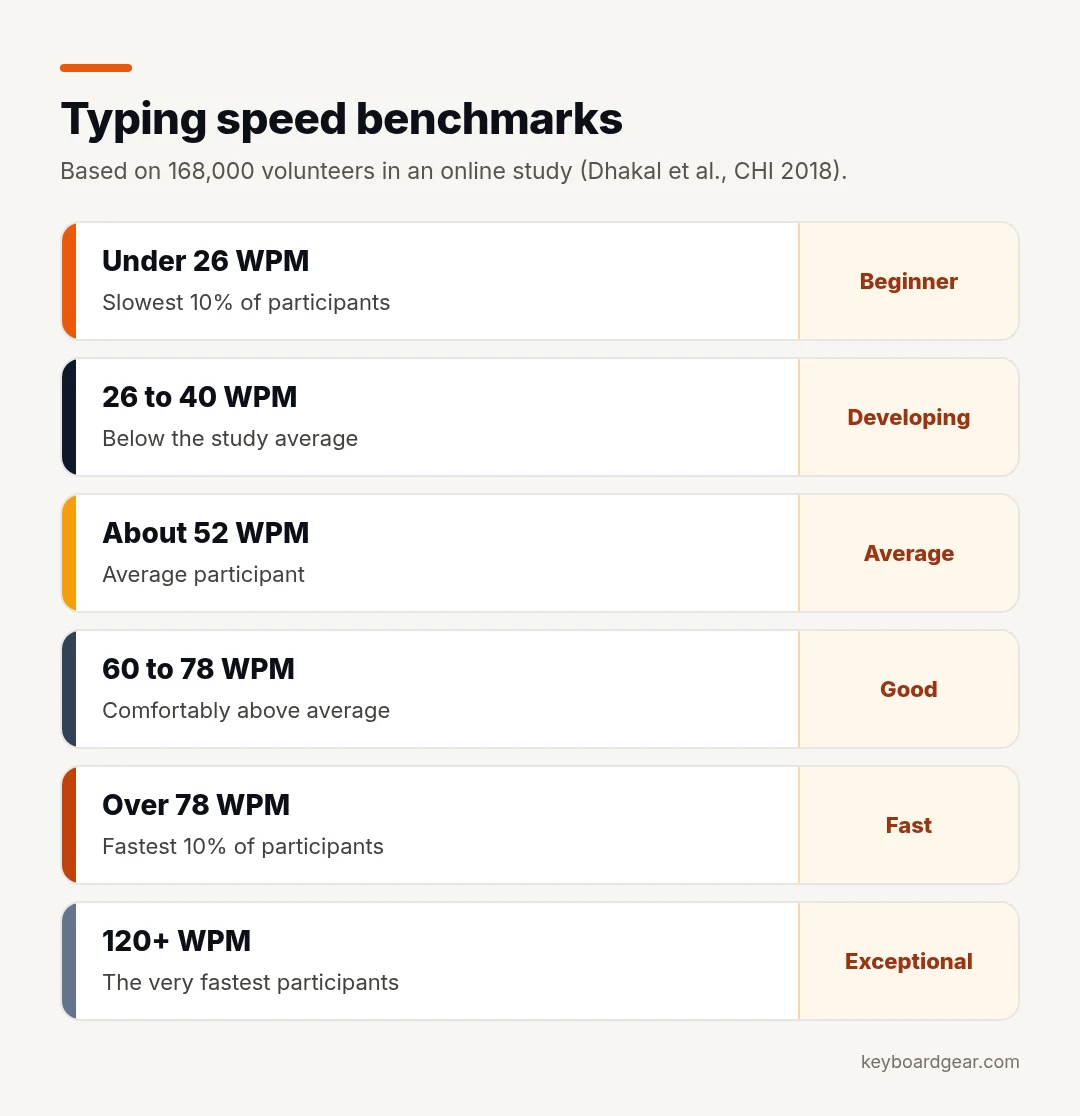
What counts as a good typing speed?
| Speed | What it means | Typical experience |
|---|---|---|
| Under 25 WPM | Hunting for keys | Typing feels slow; you often look down at the keyboard |
| 25 to 40 WPM | Functional | Fine for email and messages, slow for long documents |
| 40 to 60 WPM | Solid | Comfortable for most office work and study |
| 60 to 80 WPM | Good to fast | Typing rarely holds you back |
| 80 WPM and up | Very fast | Typical of practised touch typists and heavy writers |
For most people, 40 to 60 WPM with good accuracy is enough that typing stops being a bottleneck. Beyond that, gains are nice but matter mainly if you type for many hours a day.
How WPM is calculated
Typing tests count a “word” as five characters, including spaces and punctuation, so long and short words even out. Your WPM is the number of characters typed, divided by five, divided by the minutes taken.
- Gross WPM counts everything you typed, mistakes included.
- Net WPM subtracts uncorrected errors, so it is the fairer measure.
- Accuracy is the percentage of characters typed correctly.
Different sites calculate these slightly differently, so compare scores on the same site over time rather than across sites.
Test fairly: take three one-minute tests on the same site, use ordinary sentences rather than random words, and use your median score. A single best run flatters you.
Accuracy matters as much as speed
In the study, faster typists made fewer errors, not more. Slow typists left more mistakes uncorrected, which suggests they were less likely to notice them. Most participants corrected most of their errors, and 90% left fewer than 2.66% of characters wrong.
In practice, every mistake costs you a backspace, a correction and a moment of attention. If your accuracy drops below about 95%, slow down. Speed built on accuracy lasts; speed built on errors does not.
What makes some people faster?
The study found several habits linked with speed:
- Using more fingers. Fast typists used about 8.4 fingers on average, slow typists about 5.3. More fingers means less hand travel.
- Rollover. Fast typists often press the next key before releasing the previous one. It is a sign of fluent typing, and a reason N-key rollover matters on a keyboard.
- Consistent finger use. Using the same finger for the same key every time builds muscle memory.
- Training. People who had taken a course were faster on average, though only by about 5 WPM, so self-taught typists can be fast too.
If you still look at the keys, learning to touch type is usually the single biggest step up.
Typing speed for work and study
Some jobs test typing speed during hiring, especially data entry, transcription, administrative and customer support roles. Requirements vary by employer and country, so check the job posting rather than relying on a generic number. When a test is required, both speed and accuracy are usually scored.
For students and office workers, the right target is simply the speed at which typing no longer slows your thinking. For number-heavy work, numeric keypad speed is measured differently, in keystrokes per hour; our guide to 10-key typing covers it.
Does your keyboard affect your speed?
A little, but less than practice. A keyboard that registers every press reliably, sits at the right height and suits your finger force helps you stay accurate. Our guide to keyboard height explains the setup. Mechanical switches don’t make you faster on their own; see mechanical vs membrane keyboards for what does change.
FAQ
What is the average typing speed?
In a study of about 168,000 volunteers, the average was about 52 WPM. The general population is probably a little slower, since volunteers for typing tests tend to type more than average.
Is 40 WPM a good typing speed?
Yes, for everyday work. It is below the study average but comfortable for email, messages and most office tasks.
Is 60 WPM good?
Yes. 60 WPM is comfortably above average and fast enough that typing rarely holds you back.
What is a fast typing speed?
Over about 78 WPM put a typist in the fastest 10% of the study. The very fastest exceeded 120 WPM.
What accuracy should I aim for?
Aim for 98% or better. Below about 95%, slowing down usually raises your net speed.
How long does it take to improve typing speed?
It depends on practice and starting point. Short daily practice sessions over a few weeks usually produce noticeable gains, especially if you move from looking at the keys to touch typing.
Related guide: When Should Kids Learn to Type? What Standards and Research Say
Sources

Experience is what matters at the end!!
Hi! This is Jacob Jay – founder of Keyboardgear.com! From childhood to adulthood, I’ve always remained passionate about IT, and the revolution in this industry, especially gaming on the PC can’t go out of my way. Since I’m an enthusiastic gamer, and I love to experience various gaming accessories, particularly mechanical keyboards, that really boost my gaming adventure manifolds. So, my nerve cells hit me to transfer my experiences into word form and share with others to identify the ideal keyboards perfectly fit for their gaming modes.
I know very well how hard it is to find the high-quality items available on the internet that ought to be exactly the same as seen as on the screen. But the counterfeiters have ruined the user’s trust. As I have passed all such situations, I’m obliged to deliver the genuinity and express the same as what I am saying.
So, now, I’m working on the mission to provide very helpful and frankly but trustworthy reviews and guides about various mechanical keyboards, mouses, and other gaming accessories as per my personal experiences and sound knowledge.