

Quick answer
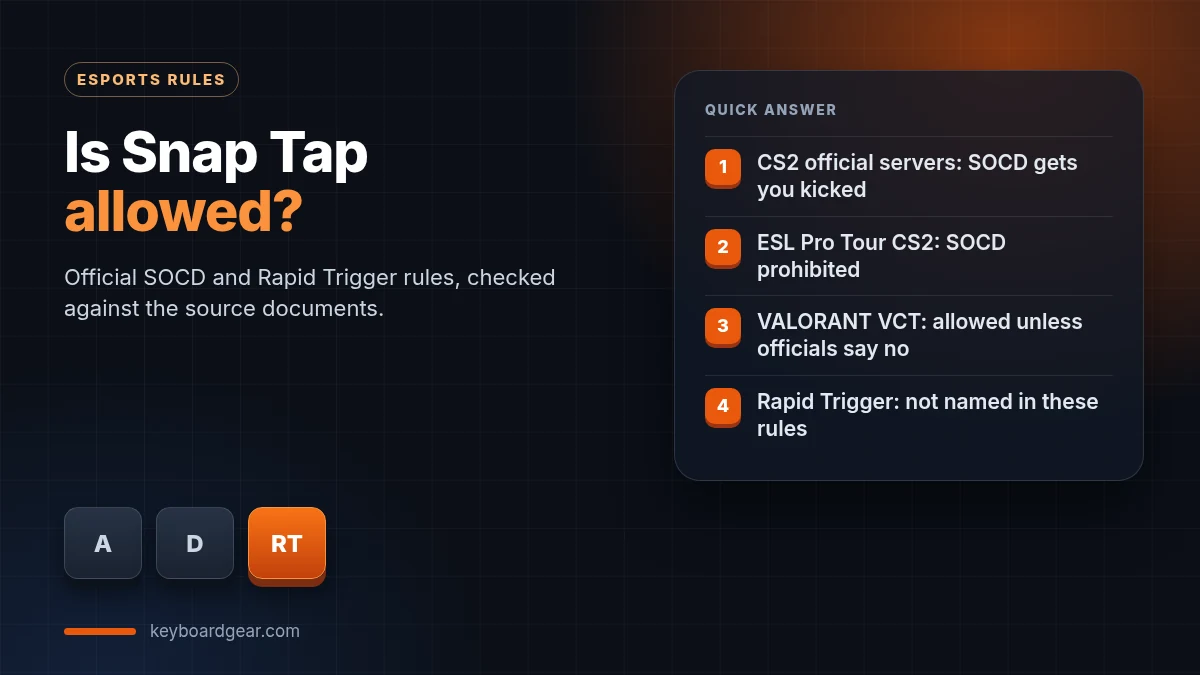
It depends on the game and the competition. Counter-Strike 2 kicks players suspected of hardware-assisted counter-strafing, such as Snap Tap, on Valve’s official servers, and ESL Pro Tour CS2 events prohibit SOCD features outright. VALORANT’s VCT rules allow Snap Tap and SOCD unless league officials say otherwise. Rapid Trigger isn’t named in any of these rules. Always check the current rules for your game and event, and turn SOCD off when in doubt.
In 2024, keyboard makers started adding features that automatically resolve what happens when you press two opposite movement keys at once. Razer called its version Snap Tap; Wooting called its Snappy Tappy and Rappy Snappy. Other brands followed with their own names. Game publishers and tournament organisers have since responded in different ways.
Here’s what the official rules say, checked against each organiser’s own published documents on November 29, 2026.
SOCD vs Rapid Trigger: what’s the difference?
These are often marketed together but do very different things.
SOCD stands for Simultaneous Opposing Cardinal Directions. If you hold A and press D, a normal keyboard reports both keys and the game decides what happens. In Counter-Strike, that makes your character stop. An SOCD feature makes the keyboard decide instead, usually by sending only the newest key, as if you’d released A. That creates a perfect counter-strafe without you lifting your finger.
Rapid Trigger changes when a single key resets. On a Hall effect keyboard, the key releases as soon as you start lifting it, rather than at a fixed point. You still have to press and release every key yourself. Our guide to Rapid Trigger and Hall effect keyboards explains it in detail.
That’s the line most rules draw: SOCD produces an input you didn’t physically perform, while Rapid Trigger makes your own inputs register sooner.
Counter-Strike 2: Valve’s official servers
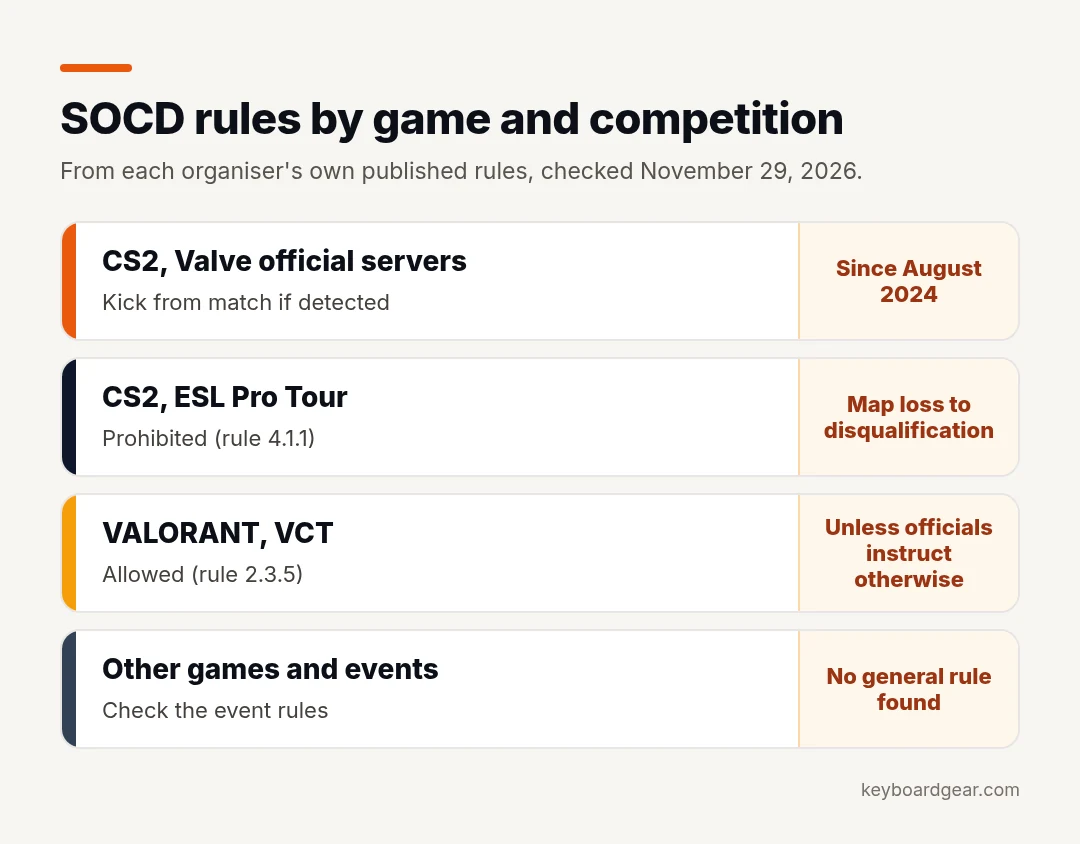
On August 19, 2024, Valve announced that it would no longer allow automation, by scripting or hardware, that replaces core skills. It said players suspected of “automating multiple player actions from a single game input” may be kicked from matches, initially on Valve official servers. Its release notes said hardware-assisted counter-strafing would be detected and result in a kick.
Valve also stopped in-game binds that combine more than one movement or attack action, such as null binds and jump-throw binds, from working by default. It advised players with features like “Snap Tap Mode” to turn them off before joining a match.
Counter-Strike 2: ESL Pro Tour
ESL announced on August 29, 2024 that Snap Tap, Rappy Snappy, SOCD and similar assistants would no longer be allowed at ESL Pro Tour in-person events. The current ESL Pro Tour Counter-Strike Rulebook 2026, rule 4.1.1, says the use of SOCD features, “including but not limited to Snap Tap, Rappy Snappy, or any similar mechanisms that produce equivalent outcomes, is strictly prohibited.” Penalties range from a default map loss to disqualification.
VALORANT: VCT
Riot took a different approach. The VALORANT Official Competition Ruleset for the VALORANT Champions Tour includes rule 2.3.5, headed “Snap Tap & SOCD”: “Unless otherwise instructed by League Officials, players may use Snaptap, SOCD, or other equivalent keyboard technologies.” We confirmed that wording in the ruleset last updated June 27, 2025.
The neighbouring rule, 2.3.4, still prohibits all macro programs, including hardware macros stored in a keyboard’s on-board memory. Our guide to keyboard macros covers how macros differ. The VCT ruleset applies to VCT competition, not ranked play or other tournaments.
Other games and tournaments
We couldn’t find a published SOCD rule from other major publishers. That doesn’t mean SOCD is allowed: third-party tournaments, leagues and anti-cheat services can set their own rules, and general fair-play terms often ban automation. If an event’s rulebook doesn’t mention SOCD, ask the organiser before you play.
What about Rapid Trigger?
None of the three rules above names Rapid Trigger, and none of their definitions describes it. Rapid Trigger is widely used by professional players. Still, check equipment rules for your event, since some require approved hardware or settings.
How to stay compliant
- Find your keyboard’s SOCD setting. Makers call it different things: Snap Tap (Razer), Rappy Snappy and Snappy Tappy (Wooting), Rapid Tap (SteelSeries), FlashTap (Corsair), Speed Tap (ASUS) and Snap Click, Last Key Priority or SOCD (others).
- Turn it off by default. Only switch it on for games and events that clearly allow it.
- Save settings to on-board memory with SOCD off, so it stays off on tournament PCs.
- Learn the toggle. Some keyboards can switch SOCD with a key combination, which is easy to trigger by accident.
- Read the rules for each event. Rules change, and organisers can override general guidance.
If you’re shopping for a keyboard, our picks of the best Hall effect keyboards list which SOCD-style features each one has, so you know what to switch off.
Rules can change at any time. This article reflects the official documents we checked on November 29, 2026. Always check the current rules for your game, server and tournament.
FAQ
Is Snap Tap bannable in CS2?
On Valve’s official servers, players suspected of hardware-assisted counter-strafing are kicked from the match. ESL Pro Tour prohibits SOCD features, with penalties up to disqualification.
Is Snap Tap allowed in VALORANT?
In VCT competition, rule 2.3.5 allows Snap Tap and SOCD unless league officials instruct otherwise. Other events may have different rules.
Is Rapid Trigger considered cheating?
No. It isn’t named in the CS2, ESL or VCT rules, because it only changes when your own key press resets.
What are null binds?
In-game binds that cancel the opposite direction key, giving a similar effect to SOCD. Valve stopped multi-action binds like these from working by default in CS2 in August 2024.
Does SOCD make you faster?
It can make counter-strafing easier, which is why some competitions ban it. It doesn’t reduce keyboard input latency.
Final thoughts
The simple rule: Rapid Trigger is generally fine, while SOCD depends on where you play. It’s banned in effect on CS2’s official servers and prohibited at ESL Pro Tour events, but allowed in VALORANT’s VCT unless officials say otherwise. Keep SOCD off by default, save that setting on your keyboard, and check the rules before every competition.
Sources
- The Verge: Valve’s CS2 announcement on Snap Tap and SOCD (August 2024)
- ESL Pro Tour: SOCD use prohibited (August 2024)
- ESL Pro Tour: Counter-Strike Rulebook 2026
- Riot Games: VALORANT Official Competition Ruleset (updated June 27, 2025)

Experience is what matters at the end!!
Hi! This is Jacob Jay – founder of Keyboardgear.com! From childhood to adulthood, I’ve always remained passionate about IT, and the revolution in this industry, especially gaming on the PC can’t go out of my way. Since I’m an enthusiastic gamer, and I love to experience various gaming accessories, particularly mechanical keyboards, that really boost my gaming adventure manifolds. So, my nerve cells hit me to transfer my experiences into word form and share with others to identify the ideal keyboards perfectly fit for their gaming modes.
I know very well how hard it is to find the high-quality items available on the internet that ought to be exactly the same as seen as on the screen. But the counterfeiters have ruined the user’s trust. As I have passed all such situations, I’m obliged to deliver the genuinity and express the same as what I am saying.
So, now, I’m working on the mission to provide very helpful and frankly but trustworthy reviews and guides about various mechanical keyboards, mouses, and other gaming accessories as per my personal experiences and sound knowledge.