
A backlit keyboard makes typing in a dim room much easier, but turning the light on isn’t always obvious. There is no universal “keyboard light” button: each laptop maker puts the control on a different key, Macs hide it in settings, and external keyboards use their own shortcuts or software. This guide shows you how to turn on the keyboard light on Windows laptops (Dell, HP, Lenovo, ASUS and others), on a MacBook, and on external and RGB keyboards, plus what to do when the light won’t come on.
Quick answer: the usual keyboard light key by brand
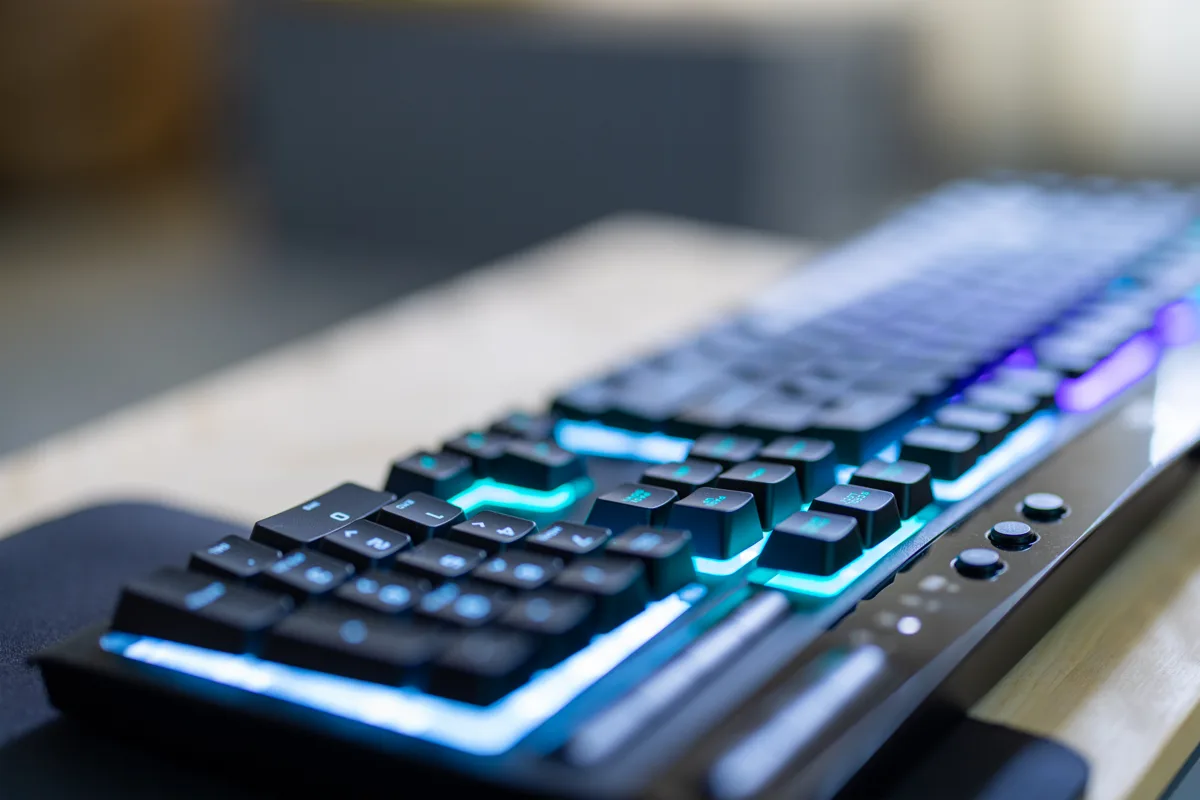
On most laptops, look along the top row for a key with a small keyboard or light-burst icon, then press it. If nothing happens, hold Fn and press it again. Press repeatedly to step through brightness levels and back to off.
| Device | Usual control | If it doesn’t work |
|---|---|---|
| Dell laptops | Fn + F5, F6, F7 or F10, or Fn + Right Arrow (some XPS) | Turn on Keyboard Illumination in BIOS (F2 at start-up) |
| HP laptops | F5, F4, F9 or F11 (with or without Fn) | Enable Action Keys Mode in BIOS (F10); install HP Hotkey Support driver |
| Lenovo laptops | Fn + Space bar | Check the model’s specs and Lenovo Vantage settings |
| ASUS laptops | Fn + F7; some models Fn + F3/F4; gaming models Fn + Up/Down | Check Armoury Crate or MyASUS and the user manual |
| MacBook | Control Center > Keyboard Brightness, or System Settings > Keyboard | Turn off auto-adjust in low light; check the light sensor isn’t covered |
| External / RGB keyboards | Fn + a lighting key, or a dedicated light key | Use the maker’s app, or Windows Dynamic Lighting |
These are the most common combinations, not a guarantee. Makers change layouts between models, so if your laptop isn’t covered here, the backlight icon on the keys is the best guide.
First, check that your keyboard actually has a backlight
Not every keyboard is backlit. Many budget and mid-range laptops are sold in both backlit and non-backlit versions of the same model, and a backlight can’t be added later with software. Before you troubleshoot:
- Look for the icon. A backlit laptop almost always has a key with a backlight symbol, usually on the function row or arrow keys. Dell’s own support guidance says that if no key shows the icon, the keyboard isn’t backlit.
- Check the specifications. Search your exact model number on the maker’s support site and look for “backlit keyboard” in the specs.
- Look at the keycaps in the dark. Backlit keyboards have translucent legends (the letters) so light can shine through them.
How to turn on the keyboard light on a Windows laptop
On Windows laptops the backlight is usually controlled by the laptop’s own firmware, not by Windows itself, so it is a keyboard shortcut rather than a Windows setting. The general method is the same on every brand:
- Find the backlight key on the function row (F1–F12), the space bar or the arrow keys.
- Press it on its own. If your laptop has Fn Lock on, or uses “action keys” by default, that’s enough.
- If nothing happens, hold Fn and press it. Fn Lock is often toggled with Fn+Esc, which is why the same key works on its own on one day and needs Fn the next.
- Press again to change brightness. Most laptops cycle through off, low and high (sometimes more levels).
Dell
Dell puts the backlight on different keys depending on the range. According to Dell’s support pages, look for the icon on F5, F6, F7 or F10 (common on Latitude, Vostro and Inspiron), or on the Right Arrow key on some XPS models. Press Fn + the backlight key to cycle through Off, Low and High; with FnLock enabled, press the key on its own.
If the keys do nothing, the backlight may be switched off in the BIOS. Restart, tap F2 at the Dell logo, open Keyboard (on older models, System Configuration) and set Keyboard Illumination to Dim or Bright. Some Dell gaming laptops with RGB keyboards are controlled through Alienware Command Center instead.
HP
HP’s support documentation says most backlit HP laptops use F5 or F4, and some use F9 or F11. Look for the backlight icon, press the key, and add Fn if needed. HP OMEN gaming laptops are controlled through OMEN Gaming Hub.
HP also notes two common fixes. If the key does nothing, enable Action Keys Mode in the BIOS (press F10 repeatedly at start-up, then look under System Configuration). If the function keys don’t respond at all, install the HP Hotkey Support driver for your model from HP’s support site. On some models the backlight turns off after 30 seconds of inactivity by default: press and hold the backlight key to choose 30 seconds, 3 minutes or Always.
Lenovo
On most Lenovo laptops, including many ThinkPad, IdeaPad and Yoga models, the shortcut is Fn + Space bar. Each press steps through the brightness levels and then off. Look for a small backlight icon on the space bar to confirm. Lenovo Vantage, the maker’s settings app, also shows keyboard backlight options on supported models. Lenovo Legion gaming laptops may use Fn + Space or the Legion software for RGB lighting.
ASUS
ASUS says the backlight key on most of its notebooks is F7: press Fn + F7 repeatedly to raise the brightness and then turn it off. Some models use Fn + F4 (brighter) and Fn + F3 (dimmer), and ROG and TUF gaming laptops usually use Fn + Up Arrow and Fn + Down Arrow. RGB effects on ASUS gaming laptops are managed in Armoury Crate.
Other brands (Acer, MSI, Microsoft Surface and more)
Other makers follow the same pattern: a function or arrow key with the backlight icon, usually combined with Fn. The user manual for your model (search the model number plus “backlit keyboard” on the maker’s site) lists the exact key. Gaming laptops often add a control app for RGB colours and effects. If your Surface keyboard isn’t responding at all, see our guide to fixing a Surface keyboard that isn’t working.
How to turn on the keyboard light on a MacBook
Apple has changed the controls over the years. Recent MacBook Air models with Apple silicon and the 14-inch and 16-inch MacBook Pro don’t have dedicated keyboard-brightness keys on the top row, so you use a slider instead. Apple’s support guide lists these methods:
- System Settings: choose Apple menu > System Settings > Keyboard and drag the Keyboard brightness slider. All the way to the left turns the light off.
- Control Center: click Control Center in the menu bar, click Keyboard Brightness and drag the slider. If it isn’t there, add it: on macOS Ventura, Sonoma or Sequoia go to System Settings > Control Center and turn on Show in Control Center or Show in Menu Bar for Keyboard Brightness; on newer versions use Edit Controls in Control Center.
- Brightness keys: older MacBooks with keyboard-brightness keys (often F5 and F6) can use those directly. On a MacBook Pro with a Touch Bar, expand the Control Strip and tap the keyboard brightness buttons.
macOS can also manage the backlight for you. In System Settings > Keyboard, Adjust keyboard brightness in low light uses the ambient light sensor near the camera, and Turn keyboard backlight off after inactivity sets how long the light stays on when you stop typing. If the light seems to switch off by itself, one of these settings is usually the reason. Apple’s external Magic Keyboards are not backlit.
How to turn on the light on an external keyboard
Desktop and wireless keyboards don’t follow the laptop shortcuts. Check these in order:
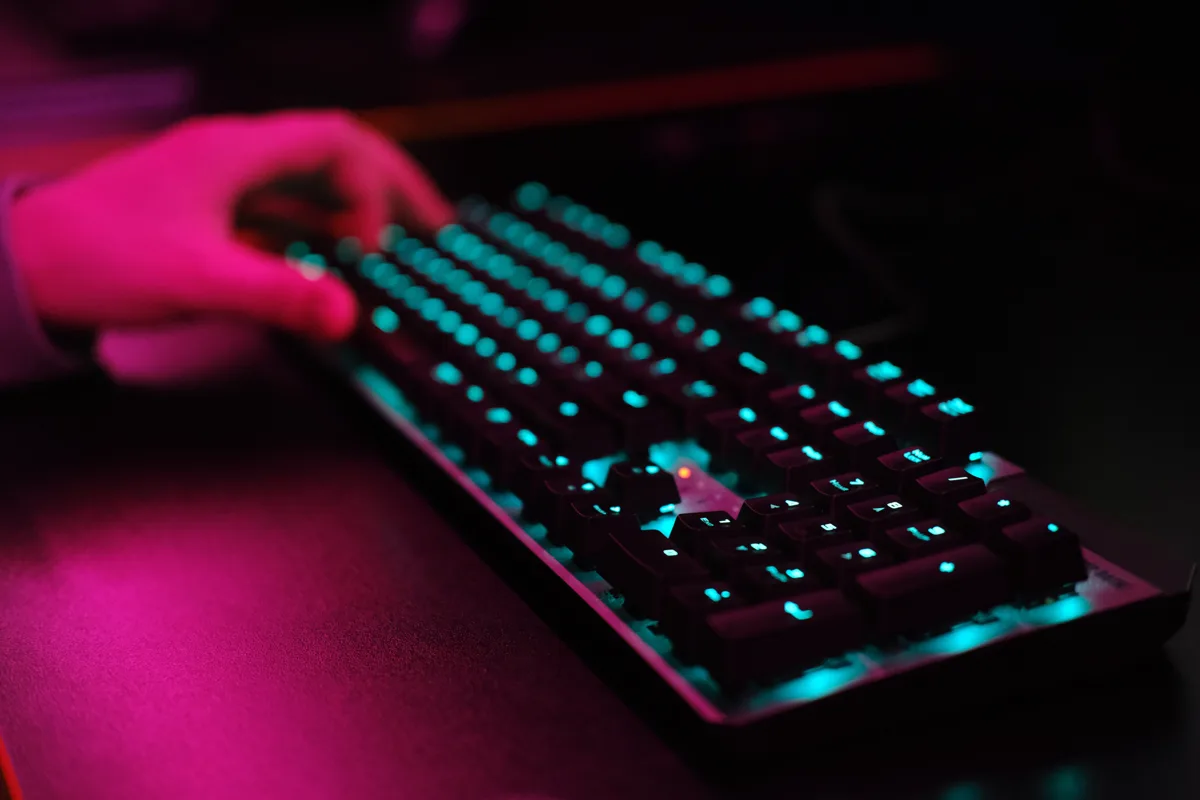
- A dedicated light key. Many keyboards have a key with a light-bulb or sun icon, often in the top-right corner or on the function row.
- Fn + a lighting key. Mechanical keyboards commonly use Fn combined with keys printed with lighting symbols (often the arrow keys or the top row) to switch the light on, change brightness and cycle effects. The quick-start card that came with the keyboard lists the exact combinations.
- The maker’s software. Gaming brands manage lighting in their own apps, such as Logitech G HUB, Razer Synapse, Corsair iCUE and SteelSeries GG. Programmable keyboards that run QMK firmware can often be set up with VIA or Vial. If the software is closed or not installed, some keyboards fall back to a default effect or stay dark.
- Wireless battery saving. Wireless keyboards often dim or switch off the backlight to save battery, and some turn it off completely when the battery is low. Logitech’s MX Keys range, for example, uses sensors to wake the backlight when your hands approach and to adjust it to the room light. Charge the keyboard and test again.
If you’re shopping for one, our roundup of the best backlit wireless keyboards focuses on keyboards with good lighting and battery life.
Windows Dynamic Lighting for RGB keyboards
Windows 11 includes Dynamic Lighting, which can control RGB keyboards and mice that support the open HID LampArray standard, without the maker’s app. Open Settings > Personalization > Dynamic Lighting, turn on Use Dynamic Lighting on my devices, and set brightness and effects for all devices or for each one. Compatible devices appear as cards at the top of the page; if yours doesn’t appear, it isn’t supported and you’ll need the maker’s software. Microsoft’s support pages note that a compatible app in the foreground, such as a game, can take control of the lighting while it’s running.
Want to understand the effects and colours on offer? Read what RGB lighting on a keyboard is and our guide to RGB keyboards.
Keyboard light not working? Try these fixes
If you’re sure the keyboard is backlit and the shortcut does nothing, work through these steps from simplest to most involved:
- Try with and without Fn. Toggle Fn Lock (often Fn+Esc) and try again.
- Press the key several times. The first press might set the lowest level, which is hard to see in a bright room. Test in a dark room.
- Check the timeout. Many laptops switch the light off after a few seconds of inactivity. Press a key or touch the touchpad; if it comes back, change the timeout in the maker’s app, the BIOS or (on a Mac) Keyboard settings.
- Check battery and power settings. Some laptops dim or disable the backlight on battery saver or when the battery is low. Plug in and test.
- Look in the BIOS or UEFI. Dell and HP both document BIOS settings that can disable the backlight or the action keys.
- Install the maker’s hotkey driver or app. Examples include HP Hotkey Support, Lenovo Vantage, MyASUS or Armoury Crate, and Dell’s or Alienware’s utilities. Update Windows and the BIOS while you’re at it.
- Restart properly. Shut down fully, wait a few seconds and start again. On some laptops the hotkeys don’t respond for the first minute after start-up while the maker’s background apps load.
- Rule out a hardware fault. Liquid damage or a loose keyboard cable can kill the backlight while the keys still type. If the light also fails in the BIOS screen, contact the maker or a repair shop.
For a wireless keyboard that is having other problems too, such as lag or dropped connections, see how to fix common wireless keyboard problems. If you use a Logitech keyboard, our guides to unlocking a Logitech keyboard and connecting a Logitech wireless keyboard may also help.
Tips for using your keyboard backlight
- Use the lowest level you need. A dim backlight is easier on the eyes in a dark room and uses less battery.
- Match the room. In daylight the backlight adds little; turn it off and save power.
- Choose a soft colour for evening work. On RGB keyboards, a single warm or white colour is usually less distracting than rainbow effects.
- Use lighting as a cue. Some keyboards and games can highlight only the keys you need, or flash when Caps Lock is on.
FAQ
Why does my laptop keyboard light turn off by itself?
Most laptops have a backlight timeout that switches the light off after a period without typing, and some also turn it off to save battery. Press a key to wake it, then change the timeout in the maker’s app, the BIOS or, on a Mac, System Settings > Keyboard.
Can I add a backlight to a keyboard that doesn’t have one?
Not with software. The backlight is a physical layer of LEDs under the keys, so a non-backlit laptop keyboard can’t be switched on. You can use an external backlit keyboard, a small desk or monitor light bar, or a USB light instead.
Why does my keyboard light key change the screen brightness instead?
Screen brightness and keyboard brightness are separate controls, often on neighbouring keys. Look for the icon that shows a keyboard or a half-lit row of keys, rather than a sun. On recent MacBooks there is no keyboard-brightness key at all, so use Control Center.
How do I change the colour of my keyboard light?
Single-colour (usually white) backlights can only change brightness. RGB keyboards change colour with Fn shortcuts, the maker’s software or Windows Dynamic Lighting if the keyboard supports it.
Does the keyboard backlight drain the battery?
Yes, a little. The effect is small on a laptop but more noticeable on a wireless keyboard, which is why many wireless models dim the light quickly or turn it off when the battery is low.
Summary
To turn on the keyboard light, find the key with the backlight icon and press it, adding Fn if needed: Fn+F5/F10 or Fn+Right Arrow on many Dells, F5, F4, F9 or F11 on HP, Fn+Space on Lenovo, Fn+F7 on most ASUS laptops. On a MacBook use the Keyboard Brightness slider in Control Center or System Settings. External keyboards use a light key, Fn shortcuts or the maker’s app, and Windows 11’s Dynamic Lighting handles compatible RGB devices. If nothing works, check the BIOS, timeout and battery settings before suspecting the hardware.

Experience is what matters at the end!!
Hi! This is Jacob Jay – founder of Keyboardgear.com! From childhood to adulthood, I’ve always remained passionate about IT, and the revolution in this industry, especially gaming on the PC can’t go out of my way. Since I’m an enthusiastic gamer, and I love to experience various gaming accessories, particularly mechanical keyboards, that really boost my gaming adventure manifolds. So, my nerve cells hit me to transfer my experiences into word form and share with others to identify the ideal keyboards perfectly fit for their gaming modes.
I know very well how hard it is to find the high-quality items available on the internet that ought to be exactly the same as seen as on the screen. But the counterfeiters have ruined the user’s trust. As I have passed all such situations, I’m obliged to deliver the genuinity and express the same as what I am saying.
So, now, I’m working on the mission to provide very helpful and frankly but trustworthy reviews and guides about various mechanical keyboards, mouses, and other gaming accessories as per my personal experiences and sound knowledge.