

Quick answer
Douglas Engelbart of the Stanford Research Institute (SRI) invented the computer mouse, and SRI chief engineer Bill English built the first prototype in 1964 from his design. It was a wooden box with two perpendicular wheels and one button. Engelbart was named inventor on the patent for an “X-Y Position Indicator for a Display System,” filed in 1967 and issued in 1970, and showed the mouse publicly in his famous demo on December 9, 1968.
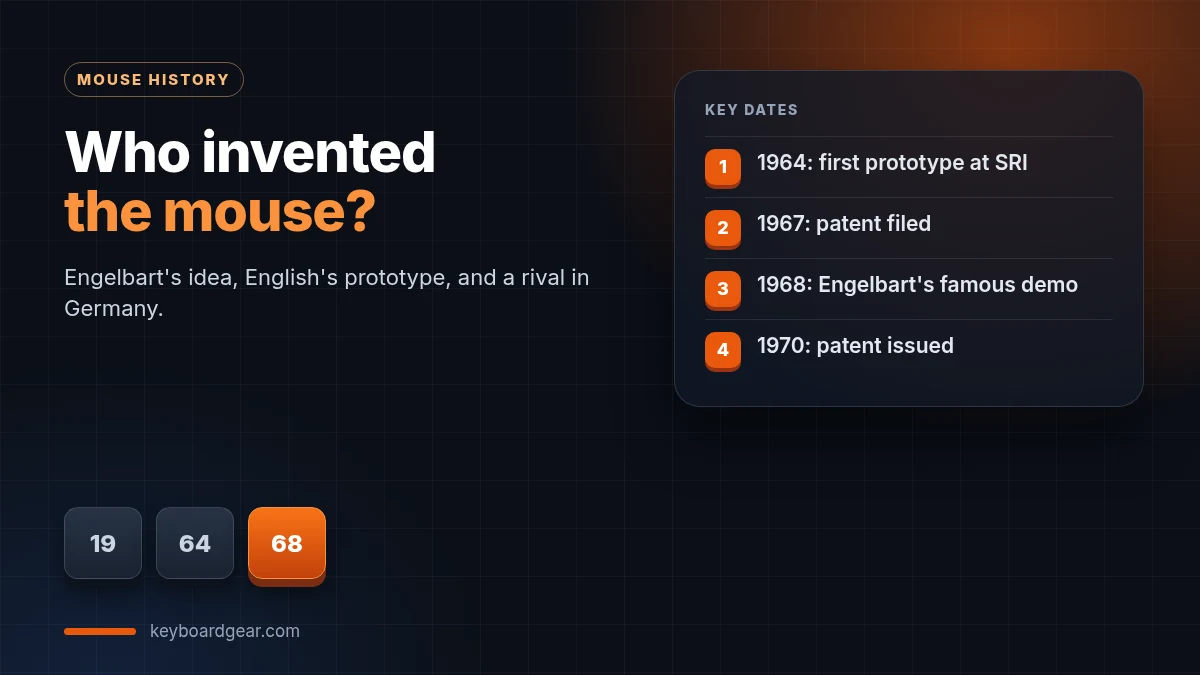
The mouse is so ordinary that it’s easy to forget someone had to invent it. The short answer is Douglas Engelbart, but the full story includes an engineer who built it, a patent that never says “mouse,” and a German company that came up with a similar idea at about the same time.
Engelbart’s idea
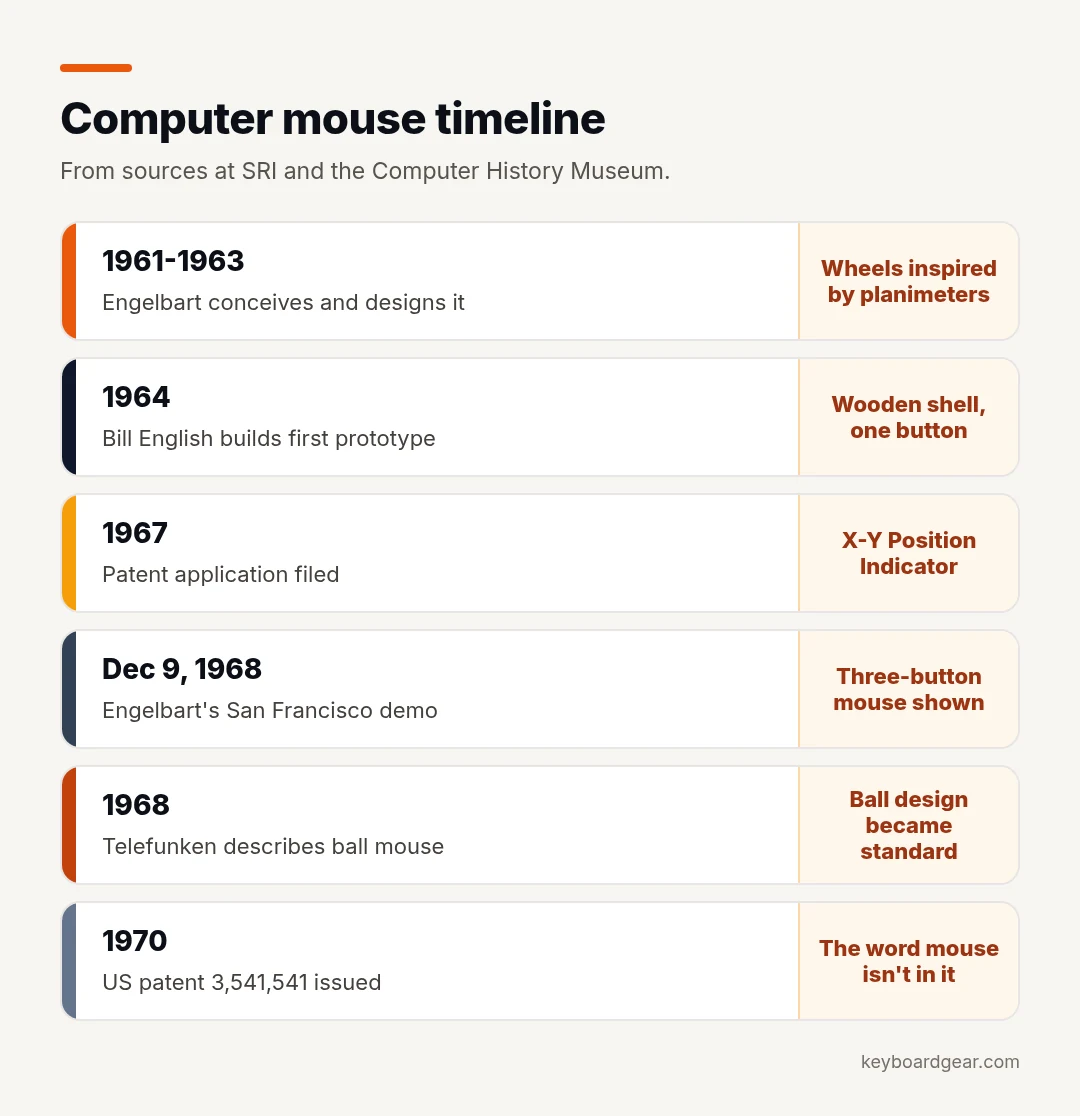
Engelbart led a research lab at SRI exploring how computers could augment human thinking. The Computer History Museum says he reportedly conceived the mouse during a conference lecture in 1961, and his first design, in 1963, used rolling wheels inspired by planimeters, mechanical area-measuring devices from the 1800s.
At the time, people pointed at screens with light pens, trackballs and joysticks. Engelbart’s team compared the mouse with other pointing devices for selecting things on screen, and it performed well enough to become the lab’s main pointer.
Bill English builds the first mouse
SRI says Bill English, then its chief engineer, built the first mouse prototype in 1964. The Doug Engelbart Institute describes it as a hand-held wooden shell with two wheels and one button. The Computer History Museum notes it used knife-edged wheels, each rolling in only one direction, with space for just one button. Later versions added more buttons.
Why is it called a mouse?
The usual explanation is that the cord coming out of the back looked like a tail, and the nickname stuck. The Computer History Museum points out that the word “mouse” doesn’t appear in Engelbart’s patent. The formal name was an “X-Y Position Indicator for a Display System.”
The patent
The patent application was filed in 1967 and issued in 1970 as US patent 3,541,541, with Engelbart named as inventor and SRI as the owner. The patent describes a device that tracks movement on a surface with two wheels, one for each axis.
The 1968 “Mother of All Demos”
On December 9, 1968, in San Francisco, Engelbart gave a 90-minute live demonstration of his lab’s work. He showed the mouse alongside hypertext links, windows on screen, real-time collaborative editing and video conferencing. The mouse in the demo had three buttons. The event is now often called “The Mother of All Demos.”
The other inventor: Telefunken
The Computer History Museum says the mouse was “invented. Twice. (Well, at least twice.)” Engineers at Germany’s Telefunken developed a mouse in the mid-1960s. First described in 1968, their version used a rolling ball, essentially an upside-down trackball. That ball design, not Engelbart’s two wheels, became the standard for decades, until optical sensors replaced it. Our optical vs laser mouse guide explains how modern sensors work.
The trackball is older than the mouse, and the two are still close relatives. If you’re curious, see our trackball vs mouse comparison.
Common myths
- “Xerox invented the mouse.” No. The Doug Engelbart Institute notes that Xerox PARC was founded in 1970, years after the mouse was built and demonstrated. Xerox did develop the mouse further for its own computers, and it later helped popularise mouse-driven computers.
- “Apple invented the mouse.” No. Apple helped bring the mouse to mainstream personal computers in the 1980s, but the invention came from SRI and Telefunken in the 1960s.
From one button to many
Engelbart’s first mouse had a single button. Today’s mice can have a dozen or more, plus scroll wheels and sensors with tracking resolutions in the tens of thousands of DPI. Our mouse terms glossary explains the modern spec sheet, and mouse side buttons covers what the extra buttons do. For the keyboard’s own history, read who invented the QWERTY keyboard.
FAQ
Who invented the computer mouse?
Douglas Engelbart at SRI. Engineer Bill English built the first prototype from his design in 1964.
When was the first computer mouse made?
In 1964, at the Stanford Research Institute (SRI).
What was the first mouse made of?
A wooden shell with two perpendicular wheels and one button.
Why is it called a mouse?
The cord coming out of the back looked like a tail. The patent itself calls it an X-Y position indicator.
Did Xerox invent the mouse?
No. Xerox PARC was founded in 1970, after the mouse was built and demonstrated.
Sources
- SRI International: The computer mouse and interactive computing
- Doug Engelbart Institute: Firsts: The Mouse
- Computer History Museum: The Mouse
- US Patent 3,541,541: X-Y Position Indicator for a Display System
Final thoughts
Engelbart had the idea, English built it, and Telefunken created the ball design that took over. Nearly 60 years on, the basic idea of moving a device across your desk to point at a screen hasn’t changed.

Experience is what matters at the end!!
Hi! This is Jacob Jay – founder of Keyboardgear.com! From childhood to adulthood, I’ve always remained passionate about IT, and the revolution in this industry, especially gaming on the PC can’t go out of my way. Since I’m an enthusiastic gamer, and I love to experience various gaming accessories, particularly mechanical keyboards, that really boost my gaming adventure manifolds. So, my nerve cells hit me to transfer my experiences into word form and share with others to identify the ideal keyboards perfectly fit for their gaming modes.
I know very well how hard it is to find the high-quality items available on the internet that ought to be exactly the same as seen as on the screen. But the counterfeiters have ruined the user’s trust. As I have passed all such situations, I’m obliged to deliver the genuinity and express the same as what I am saying.
So, now, I’m working on the mission to provide very helpful and frankly but trustworthy reviews and guides about various mechanical keyboards, mouses, and other gaming accessories as per my personal experiences and sound knowledge.