

Quick answer
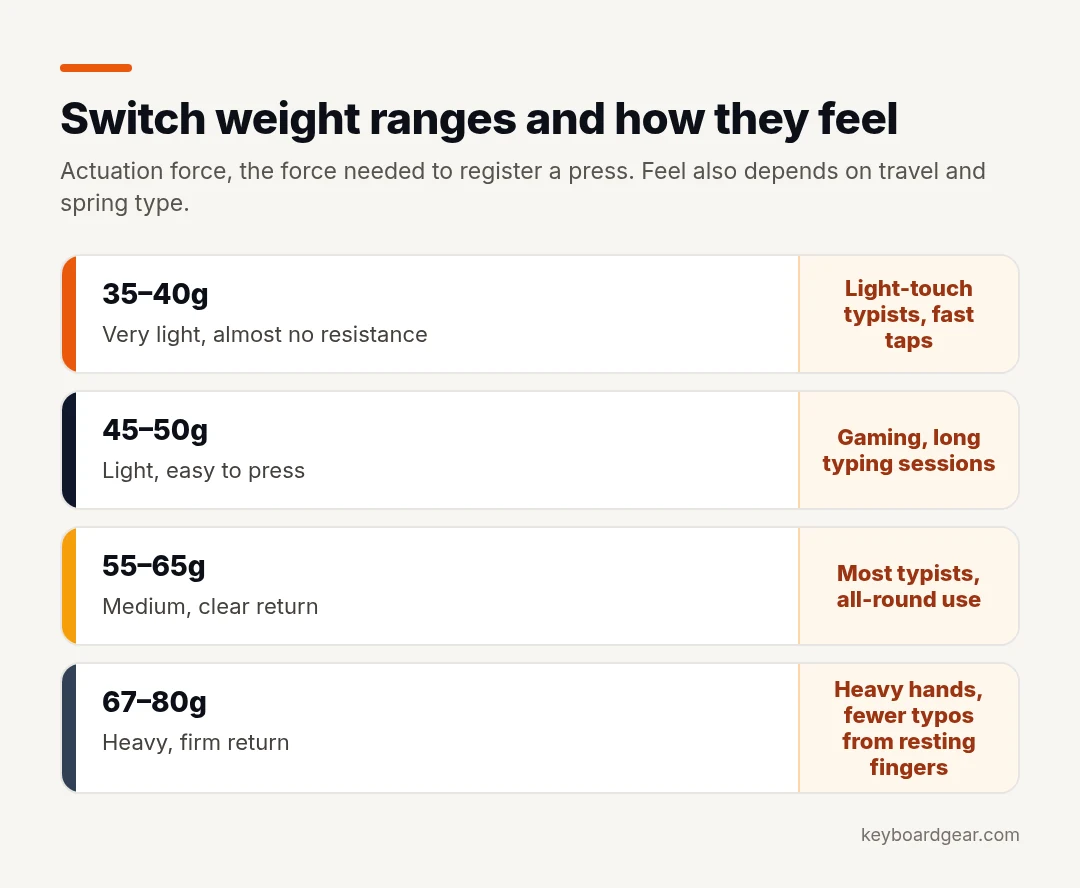
Switch spring weight is the force needed to press a key, usually given in grams-force (gf) or centinewtons (cN), which are almost the same. 35–45g feels light and fast, 50–65g is the comfortable middle most people prefer, and 67–80g feels heavy and helps if you rest your fingers on the keys or bottom out hard. Check whether a listing gives actuation force or bottom-out force, because they are different numbers.
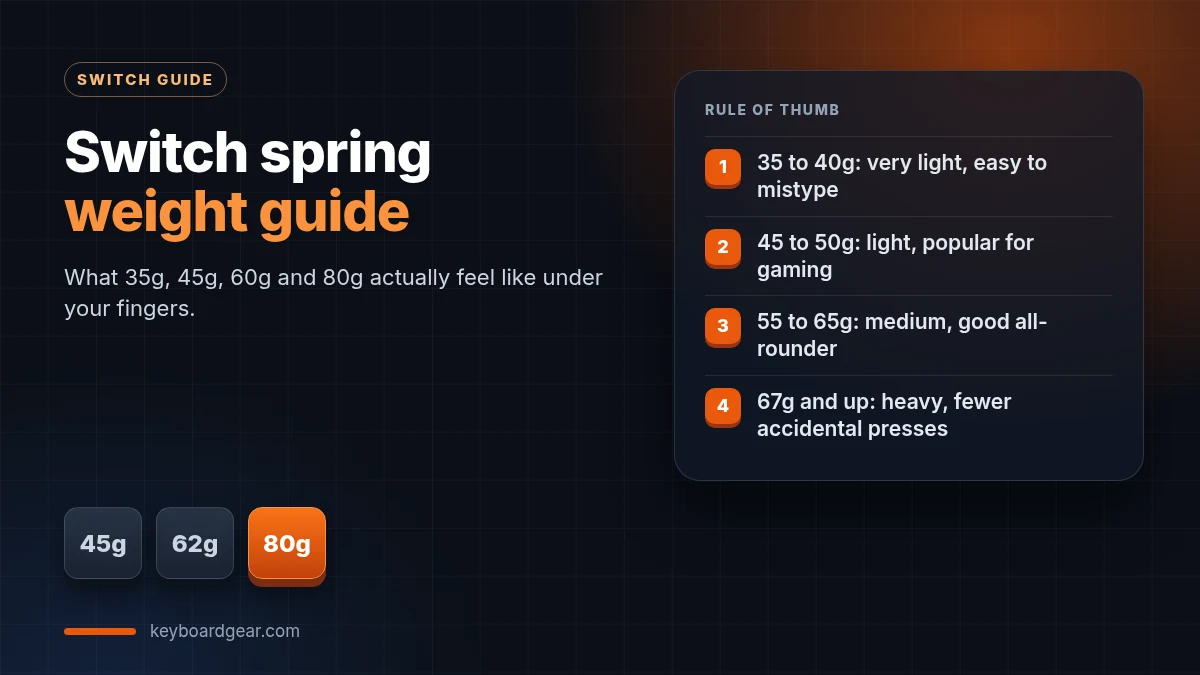
Two switches can look identical and feel completely different, and the spring is usually the reason. A heavier spring needs more force to press and pushes the key back up harder. A lighter spring feels quicker but makes accidental presses easier. Our guide to the keyboard actuation point covers how far a key travels before it registers; this guide covers how hard you have to press.
What the numbers mean
Switch makers describe force in a few ways, and listings don’t always say which they mean:
| Term | What it measures |
|---|---|
| Actuation force (operating force) | The force at the moment the switch registers a press |
| Bottom-out force | The force at the end of travel, when the key hits bottom |
| Tactile or peak force | The force at the top of the bump on tactile and clicky switches |
| Initial force | The force needed to start moving the key |
Grams-force and centinewtons are close: 1 cN is about 1.02 gf. Cherry quotes cN, while most other brands quote gf. A switch listed at “62g” by an enthusiast store is often giving bottom-out force, while a “45gf operating force” spec from a manufacturer is actuation force. Compare like with like.
Light switches: 35 to 45g
Light switches need very little force. Cherry’s MX Red, for example, is rated at 45 cN actuation.
- Feel: fast and effortless; your fingers barely work.
- Good for: gaming, light-touch typists, and people who find heavier keys tiring.
- Watch out for: accidental presses when your fingers rest on the keys, and more typos while you adjust.
Medium switches: 50 to 65g
This is where most popular switches sit, and where most people end up. Cherry’s MX Brown is rated at 55 cN and MX Blue at 60 cN.
- Feel: a clear push back from the spring without feeling stiff.
- Good for: most typing and mixed use.
- Watch out for: not much. If you’re unsure, start here.
Heavy switches: 67 to 80g
Heavy springs push back firmly. Few stock switches start this high; heavy weights are more common in enthusiast switches and aftermarket springs, which are often labelled by bottom-out force.
- Feel: deliberate and solid, with a strong return.
- Good for: heavy-handed typists who bottom out on every key, and anyone who rests their fingers on the keys.
- Watch out for: finger fatigue over long sessions, especially if you are not used to it.
Spring types
The spring’s shape changes how force builds through the press:
- Standard (single-stage): force rises steadily from top to bottom. Most stock switches use this.
- Long or extended springs: more coils in the same space give a more even feel, with a higher starting force and a gentler rise.
- Two-stage: two sections of different stiffness, light at the start and firmer near the bottom, which softens bottom-out.
- Progressive: force ramps up more steeply towards the end of travel.
How to choose your weight
| If you… | Try |
|---|---|
| Get tired fingers or hand ache after long sessions | Lighter: 45 to 50g |
| Press keys by accident when resting your hands | Heavier: 60 to 67g |
| Bottom out hard on every key | Medium to heavy, or a two-stage spring |
| Play fast-paced games | Light linear: 40 to 50g |
| Are not sure | Medium: 55 to 62g |
The best way to choose is to try a few. A switch tester lets you press several weights side by side for little money. If you already know you like smooth keys, our list of the best linear switches gives force specs for each pick, and the best tactile switches does the same for bumpy ones.
Can you change the spring?
Yes, on most MX-style switches. Opening a switch to swap the spring is often done at the same time as lubing; our guide on how to lube keyboard switches shows how to open a switch safely. It takes time, so it is usually easier to buy a switch with the weight you want and swap the switches on a hot-swap board.
Spring weight is about comfort and preference, not a treatment. If you have ongoing pain when typing, read our guide to wrist pain from typing and speak to a health professional.
FAQ
What is a good switch weight for typing?
Most people are comfortable between about 45g and 65g actuation force. Start around 55g and adjust lighter or heavier based on how your fingers feel.
Are heavier switches better?
Not in general. Heavier switches reduce accidental presses but can tire your fingers. Lighter switches are faster but less forgiving. It depends on how you type.
Is 45g or 62g better for gaming?
Many gamers prefer lighter linear switches around 40 to 50g for quick presses, but it is personal preference.
What is the difference between gf and cN?
Both measure force. One centinewton is about 1.02 grams-force, so the numbers are nearly interchangeable.
What does bottom-out force mean?
It is the force at the very end of the key’s travel. It is always higher than actuation force on a standard spring, so check which one a listing uses.

Experience is what matters at the end!!
Hi! This is Jacob Jay – founder of Keyboardgear.com! From childhood to adulthood, I’ve always remained passionate about IT, and the revolution in this industry, especially gaming on the PC can’t go out of my way. Since I’m an enthusiastic gamer, and I love to experience various gaming accessories, particularly mechanical keyboards, that really boost my gaming adventure manifolds. So, my nerve cells hit me to transfer my experiences into word form and share with others to identify the ideal keyboards perfectly fit for their gaming modes.
I know very well how hard it is to find the high-quality items available on the internet that ought to be exactly the same as seen as on the screen. But the counterfeiters have ruined the user’s trust. As I have passed all such situations, I’m obliged to deliver the genuinity and express the same as what I am saying.
So, now, I’m working on the mission to provide very helpful and frankly but trustworthy reviews and guides about various mechanical keyboards, mouses, and other gaming accessories as per my personal experiences and sound knowledge.